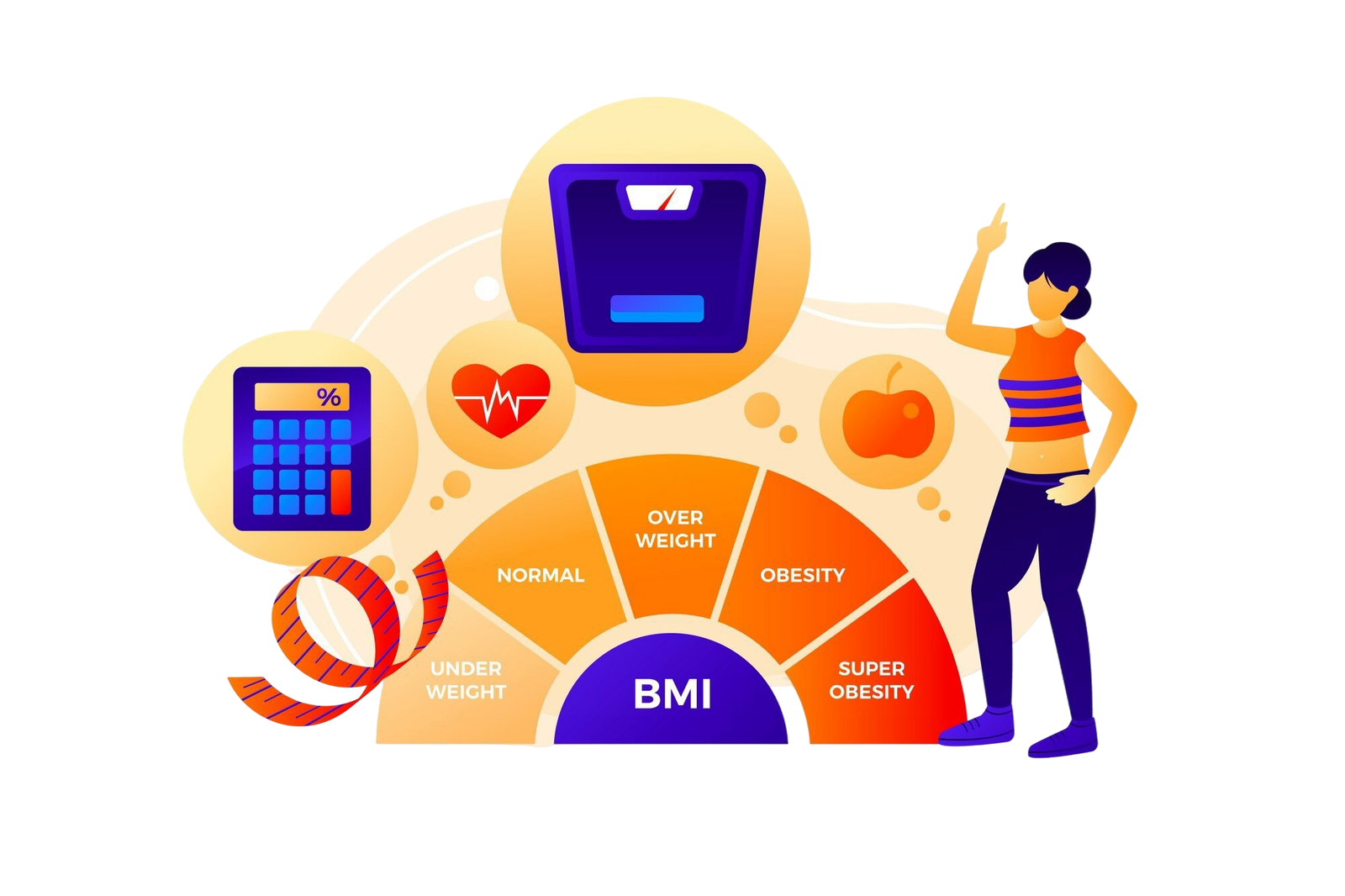
A BMI Calculator uses height and weight to calculate body mass index. The metric formula is weight in kilograms divided by height in metres squared.
For example, an adult weighing 70 kg and measuring 1.75 m has a BMI of approximately 22.9.
That number describes weight relative to height. It does not directly measure body fat or provide a complete assessment of health.
What Is Body Mass Index?
Body mass index, usually shortened to BMI, is a screening measure calculated from two measurements: height and weight.
It offers a quick way to identify weight-for-height categories that may warrant further assessment. Its simplicity also makes it useful for studying population trends.
The distinction is important: BMI can support screening without explaining an individual’s body composition or medical circumstances. The CDC’s explanation of BMI describes its role alongside other health information. CDC
How to Calculate BMI
Choose the formula that matches your measurement units. Mixing kilograms with inches, or pounds with metres, will produce an incorrect result.
Metric Formula
\[ \text{BMI}=\frac{\text{weight in kg}}{(\text{height in m})^2} \]
For a weight of 70 kg and height of 1.75 m:
\[ 1.75\times1.75=3.0625 \]\[ 70\div3.0625=22.857142\ldots \]
Rounded to one decimal place:
\[ \boxed{\text{BMI}\approx22.9} \]
BMI is conventionally expressed in kg/m². It is not a percentage.
Using Height in Centimetres
Convert centimetres to metres before using the metric formula:
\[ 175\text{ cm}\div100=1.75\text{ m} \]
Alternatively:
\[ \text{BMI}=\frac{\text{weight in kg}\times10{,}000}{(\text{height in cm})^2} \]
For the same example:
\[ \frac{70\times10{,}000}{175^2}\approx22.9 \]
Imperial Formula
When using pounds and inches:
\[ \text{BMI}\approx \frac{\text{weight in lb}}{(\text{height in inches})^2}\times703 \]
The factor 703 is a rounded unit-conversion factor.
For an adult weighing 160 lb and measuring 5 feet 8 inches:
\[ \text{height}=5\times12+8=68\text{ inches} \]\[ \text{BMI}\approx\frac{160}{68^2}\times703 \approx24.3 \]
CDC publishes both metric and US customary BMI formulas. CDC
Five feet eight inches is 68 inches, not 5.8 feet. Similarly, 11 stone 6 pounds is 160 pounds, not 11.6 stone.
Understanding Common Adult BMI Categories
The following table shows the standard categories used by CDC for adults aged 20 and older.
|
BMI, kg/m² |
Standard screening category |
|
Below 18.5 |
Underweight |
|
18.5 to below 25 |
Healthy weight |
|
25 to below 30 |
Overweight |
|
30 or higher |
Obesity |
These are screening categories, not diagnoses. A category does not establish an individual’s overall health or determine treatment by itself. See the CDC adult BMI category reference for the published ranges. CDC
“Below 25” is more precise than treating 24.9 as an absolute upper boundary: values such as 24.95 are still below 25 before rounding.
A Rounded Display Can Hide a Boundary
A value of 24.96 rounds to 25.0 at one decimal place, although its unrounded value is below 25.
When comparing tools, check whether categorization uses the underlying result or the rounded display. A small numerical difference should not be interpreted as a sudden change in health.
What Does Your BMI Result Mean?
Separate the result into three questions:
|
Question |
What it tells you |
|
Was it calculated correctly? |
Whether the formula and units were applied properly |
|
Which category applies? |
Where the result falls under the selected reference |
|
What does it mean for health? |
Requires additional individual information |
A healthcare professional may consider medical history, blood pressure, laboratory findings, physical examination and other relevant factors alongside BMI. CDC
A result outside the standard healthy-weight range does not independently establish that someone is unhealthy. A result within it does not exclude health problems.
UK Guidance Adds Important Context
The NHS adult BMI guidance explains that people from Asian, Black African, African-Caribbean and Middle Eastern backgrounds can develop certain health problems at lower BMI values.
This affects interpretation and advice. It does not change the basic weight-divided-by-height-squared arithmetic. NHS
Is BMI an Accurate Measure of Health?
A BMI calculation can be mathematically accurate while remaining an incomplete health measure.
It Cannot Separate Muscle From Fat
Body weight includes muscle, fat, bone and other tissues. BMI does not identify how much each contributes.
Someone with substantial muscle mass may have a BMI in a higher category without that number revealing their body fat level. CDC
It Does Not Show Fat Distribution
BMI does not identify where fat is carried. Two people with the same BMI can have different body compositions and fat distributions.
The number also does not describe strength, fitness or the findings of a medical examination. CDC
The Formula Does Not Capture Every Individual Difference
Age-related changes in body composition are not directly represented in the basic formula. Nor does it contain information about symptoms or medical history.
These limitations are reasons to interpret BMI in context, rather than to dismiss it entirely.
BMI vs. Body Fat Percentage
|
Measure |
What it represents |
|
BMI |
Weight relative to squared height |
|
Body fat percentage |
The proportion of total body mass made up of fat |
A BMI of 25 does not mean 25% body fat. BMI alone cannot supply a body fat percentage. CDC
Neither number, considered alone, provides a complete health assessment.
Adults, Children and Teenagers Need Different Interpretation
The BMI arithmetic can be the same, but children’s results require age- and sex-specific growth references.
|
Service |
Adult calculator age range |
Child/teen calculator age range |
|
CDC, United States |
20 and older |
2 through 19 |
|
NHS, United Kingdom |
18 and older |
2 through 17 |
Follow the intended age range and reference used by the service. Do not apply a general adult category table to a child’s result. cdc.gov
A pediatric BMI percentile compares a child’s result with an age- and sex-specific reference population. It is not a body fat percentage. cdc.gov
When a General BMI Tool Is Not Appropriate
The NHS advises against using its general adult calculator during pregnancy, when an eating disorder is diagnosed or suspected, or when a condition affects height.
If any of these circumstances apply—or interpreting weight measurements causes distress—seek individualized guidance rather than relying on a general category. NHS
Using a BMI Calculator Thoughtfully
Before calculating:
- Check the tool’s intended age range.
- Use the units requested by its fields.
- Convert feet and inches or stones and pounds correctly where necessary.
- Read the result alongside the tool’s interpretation guidance.
To try the calculation, use CalculatorPace’s BMI Calculator once its destination and supported inputs have been confirmed.
Editorial link placeholder: attach the verified CalculatorPace BMI Calculator URL to the bold anchor before publication.
Treat the result as a screening reference, not a personal weight target or a diagnosis.
Frequently Asked Questions
What is a healthy BMI for adults?
The standard adult screening range is 18.5 to below 25. Individual interpretation still depends on the appropriate reference and personal health circumstances.
Does the BMI formula differ for men and women?
The basic adult formula uses height and weight and does not contain a sex-specific adjustment. Body composition can differ, which is one reason the result needs context.
Does age change the BMI calculation?
Age is not a variable in the basic formula. It matters when selecting an appropriate reference, particularly for children and teenagers.
Can BMI be misleading for muscular people?
Yes. BMI cannot distinguish muscle from fat, so substantial muscle mass can contribute to a higher BMI without revealing body fat level.
Why do two BMI calculators give slightly different results?
Differences can arise from measurement precision, unit conversion and rounding. Also check whether the tools use the same age range and interpretation framework.
Can BMI tell me how many calories to eat?
No. BMI does not calculate daily energy expenditure or establish an appropriate calorie intake.
Can BMI alone determine whether I am healthy?
No. It is one screening measure and should be considered alongside other relevant health information.